
Can You Put Laminate or Vinyl Plank Over Tile?
Often, yes: a floating laminate or vinyl plank floor can go over tile that is flat and firmly stuck down. The grout lines get filled level first. Published installation guides from flooring makers allow it. A floating floor sits on top and is never nailed or glued to the tile.
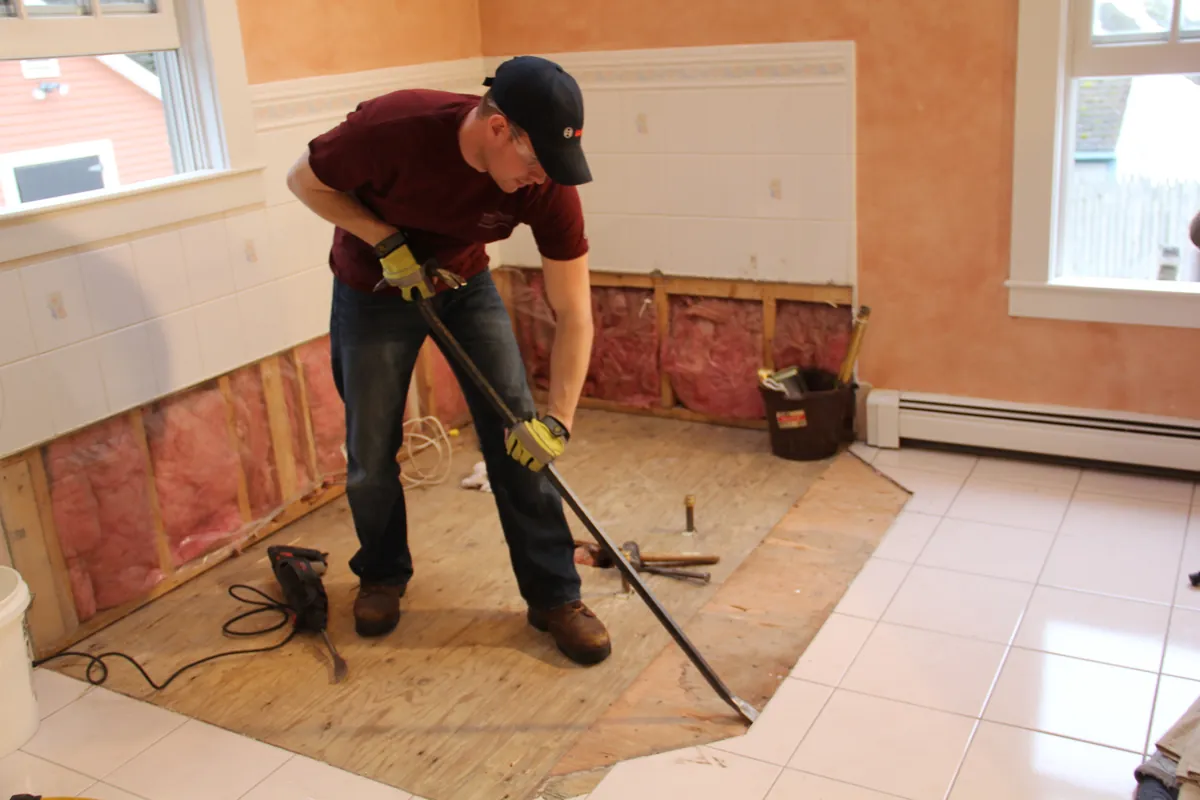
We would pull the tile when tiles are loose or cracked, or when the floor is badly out of flat. We would also pull it when the added height fouls doors, appliances, trim or the strips between rooms. If you have old 9 by 9 floor tile, it gets tested before anyone grinds it or tears it out. When the tile has to go, tile removal is the work we do.
What do the guides say about putting laminate over tile?
A laminate flooring trade group lists ceramic tile among the floors laminate can go over. Its guide says to install over flat, smooth ceramic tiles after checking for any cracked or loose tiles. Porcelain tile gets the same test: flat, level and in good condition.
One laminate maker’s installation guide says its floors can go over most existing floors that are firmly stuck down. The surface has to be flat within 3/16 inch per 10 foot radius. High spots get leveled and low spots get filled, and any looseness gets secured.
Moisture comes next. The same guide requires a vapor barrier over concrete and over ceramics. It calls for plastic film 6 to 8 mils thick, and an underlayment attached to the plank does not count. The trade group also calls for a 6 mil vapor barrier and underlayment padding on a concrete slab.
The laminate guide and the vinyl plank guide below both want at least a 1/4 inch gap at the walls. The baseboard or quarter round goes back on to cover it.
What about vinyl plank over tile?
A vinyl plank maker’s instructions say its floating planks can go over most hard surface floors in a home. The old floor must be smooth and solid, one layer thick and fully stuck down. The maker calls for a cement-based leveler to smooth and level that floor first.
On a tile floor, the grout lines are the grooves. The same instructions say to fill and level grooves and other uneven spots with a cement-based patching compound. The floor must be level within 1/8 inch in 8 feet, a tighter number than the laminate guide’s.
Glue-down vinyl asks more of a tile floor. For floors glued over ceramic tile, the same maker says glazing and sealers must be completely removed. Very smooth surfaces get roughed up, then smoothed and leveled with a cement-based patching compound. If needed, moisture tests come first.
That manual also says the final decision to cover an existing floor rests with the flooring contractor or installer. Your installer makes that call on your floor.
Can you put hardwood or carpet over tile?
Hardwood depends on the type. A hardwood flooring maker says its floating engineered floors can go over vinyl or tile. The old floor has to be flat and secure.
Solid hardwood is a different install. The same maker says solid planks must be nailed, and even glued, to a stable subfloor. If solid wood is your plan, ask your installer what has to come up first.
With the tile gone, a wood flooring trade group says solid and engineered wood floors can go over concrete. The concrete must be properly prepared: flat, dry and free of cracks, loose areas and hollow spots.
For carpet over tile, ask the carpet installer what goes underneath. The guides above cover old carpet under a new floor, and they want it gone. The laminate trade group says carpet, padding and staples all come out first. That tear-out is part of our floor demolition work.
Should you go over the tile or take it out?
Here is how the guides line up, one tile condition at a time.
| Tile floor | What the guides say | Go over it or take it out? |
|---|---|---|
| Flat and tight | A laminate trade group says to install over flat, smooth ceramic tile. A vinyl plank maker wants the old floor fully stuck down. | Go over it, with the grout lines filled |
| A few loose or cracked tiles | The trade group says to check for cracked or loose tiles first. A laminate maker says any looseness gets secured. | Fix them first, or take it out if many are loose |
| Out of flat or lippage (tile edges at different heights) | Laminate: flat within 3/16 inch per 10 foot radius. Vinyl plank: level within 1/8 inch in 8 feet. High spots leveled, low spots filled. | Level it, or take it out and grind the slab flat |
| Height problems at doors and appliances | Undercut doorway moldings to the thickness of the new floor. Cabinets and kitchen islands do not go on top of a floating floor. | Take it out if the new floor will not clear |
| Old 9 by 9 vinyl tile | A vinyl maker says to presume old vinyl flooring contains asbestos unless you are certain it does not. Do not sand, dry scrape or drill it. | Test it before anything else |
| A basement slab with moisture | A laminate maker requires a vapor barrier over concrete and ceramics. The trade group says to watch for moisture below grade and avoid floors with drains. | Test the slab first, either way |
Going over tile stacks the new floor on top of the old one. Check your doors and the dishwasher opening before you buy flooring.
New Jersey’s health department lists vinyl floor tiles, usually 9 by 9 inches, among household products that could contain asbestos. That floor gets tested before any tear-out or grinding. A positive test makes the next step a call for an asbestos professional, and we hold off. A negative test puts it back in the table above.
What does it cost to take the tile out first?
Going over the tile skips the removal cost. A national cost calculator put tile removal at about $3.05 to $5.64 per square foot in May 2026. That is a market number, not our price list. Our post on flooring removal costs prices the mortar under the tile as its own line.
Going over tile has its own prep: filling grout lines, leveling, a vapor barrier and undercutting doorway moldings. Taking the tile out leaves one new floor on a clean slab instead of two floors stacked up.
Where does SF Huling fit in?
SF Huling takes out the old tile and the thinset under it. We use concrete grinding and floor prep to grind off what is left and flatten the slab. That leaves a clean, flat slab, and your flooring installer puts the new floor down. Our part ends at the slab.
On a concrete slab, you can also skip the new floor and have us coat the bare concrete with epoxy. We pull tile before we coat, and our post on epoxy over tile explains why. We tear out ceramic tile, VCT and wood flooring across Central Pennsylvania. SF Huling is based in Lock Haven and backed by 30 years of commercial flooring experience.
Ready to take the tile out?
If your tile failed a check above, tile removal is the next step. We take out the tile and the thinset, then leave the slab ready for your installer or an epoxy coating. Estimates are free. Call or text (570) 772-2721.